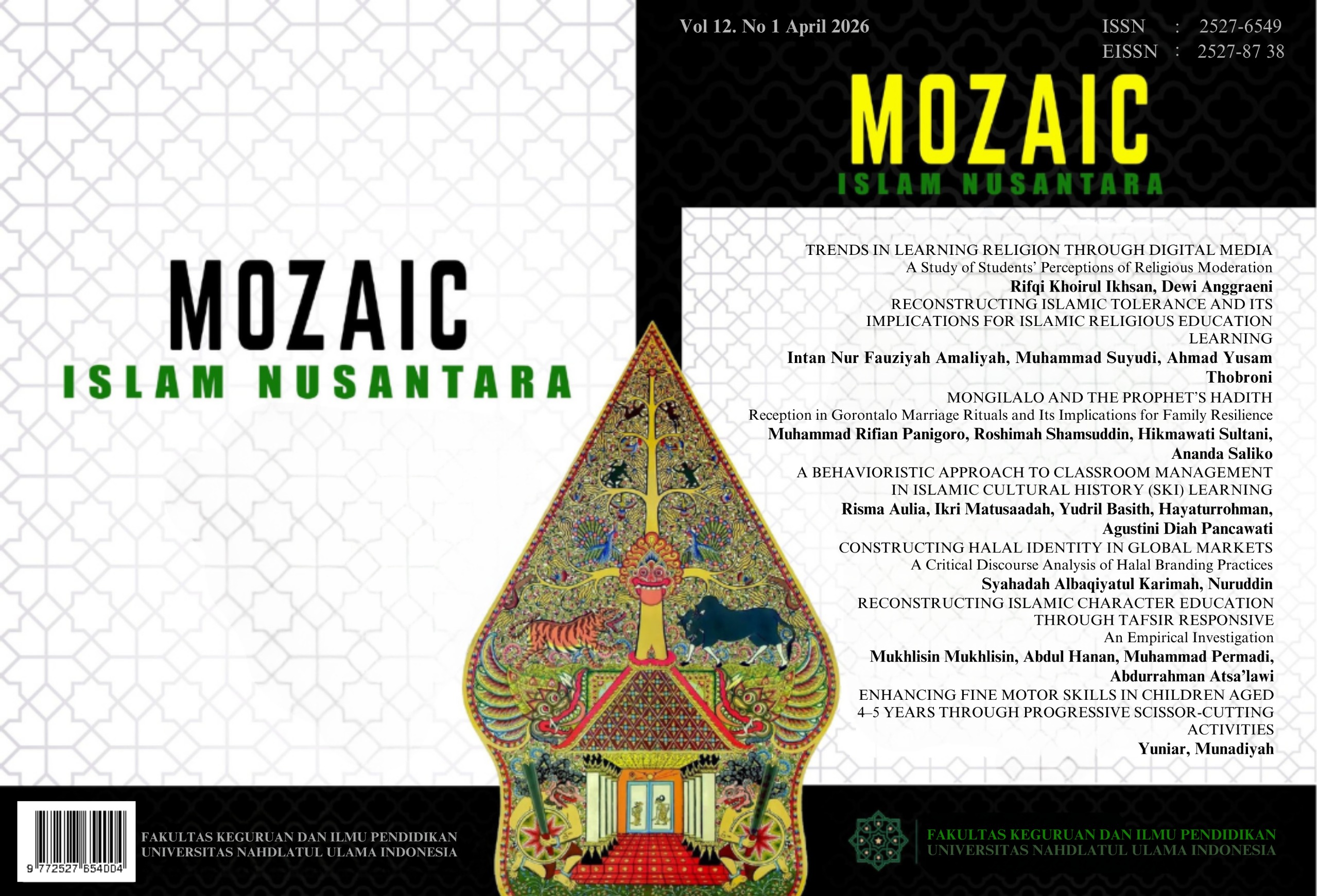
Reconstructing Islamic Character Education through Tafsir Responsive
An Empirical Investigation
DOI:
https://doi.org/10.47776/mozaic.v12i1.2043Keywords:
Character, Pesantren, Responsive TafsirAbstract
This study examines the escalating crisis in Islamic character education, reflected in moral deterioration, increasing radical tendencies, and the widening gap between traditional Qur’anic understanding and contemporary social realities. The study aims to reconstruct Islamic character education through the development of Responsive Tafsir as a contextual and integrative pedagogical model of Qur’anic interpretation. A qualitative descriptive case study approach was employed, with data collected over six months through in-depth interviews, participant observation, and document analysis at Pesantren Babakan Cirebon. The findings reveal that Responsive Tafsir is built upon three principal foundations: maqasid-based interpretation, contextual hermeneutics, and the Living Qur’an approach. These elements transform tafsir into a dynamic, practice-oriented educational pedagogy. Its implementation is reflected in thematic learning, dialogical interaction, contextual application, and collaborative interpretation, all of which encourage active student participation and deeper value internalization. Empirically, the model contributes to the development of key character dimensions, including religious moderation, social awareness, intellectual integrity, empathy, and moral autonomy. The study further demonstrates that Responsive Tafsir functions as an educational strategy to counter radicalism by cultivating students’ critical and contextual interpretive capacities. Conceptually, this study positions Responsive Tafsir not as a grand theory, but as a pedagogical model that bridges classical Islamic scholarship with contemporary educational needs. Therefore, Islamic educational institutions are encouraged to adopt this pedagogical approach by strengthening contextual interpretation practices and enhancing teachers’ competencies in responsive hermeneutics to support sustainable character development.
References
Birhan, W., Shiferaw, G., Amsalu, A., Tamiru, M., & Tiruye, H. (2021). Exploring the context of teaching character education to children in preprimary and primary schools. Social Sciences & Humanities Open, 4(1), 100171. https://doi.org/10.1016/j.ssaho.2021.100171
Center for Education and Cultural Policy Research. (2022). Survey of community needs for character education based on religious values in schools.
Creswell, J. W., & Plano Clark, V. L. (2018). Designing and Conducting Mixed Methods Research (3rd ed.). SAGE Publications.
Dewey, J. (1938). Experience and Education. Macmillan.
Getty, V. (2025, November). Educating for Character. BBC News Indonesia. https://www.bbc.com/indonesia/articles/c3979kem2lmo
Hanan, A. (2025). J u r n a l I l m u – I l m u K e i s l a m a n. 341, 313–341.
Istiyani, D., Karnadi, K., & Nasikhin, N. (2025). Building a moderate generation through inclusive education: A case study in semi-modern Islamic boarding schools. Ta’dib, 28(2), 373–396. https://doi.org/10.31958/jt.v28i2.15993
Ladson-Billings, G. (2021). Culturally relevant pedagogy: Asking a different question. Teachers College Press.
Lincoln, Y. S., & Guba, E. G. (1985). Naturalistic inquiry. SAGE Publications.
Malik, A., Amrullah, K., & Aminatuz, I. (2025). The Challenges of Developing Islamic Education Curriculum and Strategies for Its Development in Facing Future Competency Demands. 6(1), 111–126.
Miles, M. B., & Huberman, A. M. (1994). Qualitative Data Analysis: An Expanded Sourcebook (2nd ed.). Sage Publications.
Miles, M. B., Huberman, A. M., & Saldaña, J. (2021). Qualitative data analysis: A methods sourcebook. SAGE Publications.
Mukhlisin & Atsalawi, A. (2026). Humanistic Integration in Pesantren Education : Enhancing Moral and Social Character at Pondok Pesantren Lirboyo. Ta’dib: Journal of Islamic Education, 4(1), 1–13. https://doi.org/10.69768/jt.v4i1.99
Mukhlisin, M., & Atsalawi, A. (2026). Akhlaqul Banin as a Paradigm of Islamic Character Education : An Implementation Study at Madrasah Aliyah Negeri 2 Kuningan. 1(2), 56–63.
Mukhlisin, M., & Sofy, M. (2025). Pendampingan dan Peningkatan Perilaku Keagamaan Remaja Pasca Pendidikan Dasar melalui Kultur Pesantren di Desa Sindangbarang. KOMUNITA: Jurnal Pengabdian Dan Pemberdayaan Masyarakat, 4(2), 173–184. https://doi.org/10.60004/komunita.v4i2.169
Mukhlisin, M., Yuniawati, R. I., & Atsa’lawi, A. (2023). The Implementation of Prophet’s Character Education at Al-Multazam II. EduMasa: Journal of Islamic Education, 1(1), 13–23. https://edumasa.ipeba.ac.id/index.php/EduMasa/article/view/4
Mukhlisin Mukhlisin; Malik Sofy; (2025). Kultur pesantren. Intake Pustaka.
Norvaizi, I., Anggita, L., Sulistri. (2025). Pendidikan Pembebasan Perspektif Paulo Freire. Abdurrauf: Journal of Education and Islamic Studies, 1(3). https://journal.abdurraufinstitute.org/index.php/arjeis/article/view/225
Permadi, M., & Risnawati, A. (2025). Meningkatkan Hasil Belajar IPA Melalui Metode Pemberian Tugas di Kelas V SD Negeri 35 Talang Kelapa. Journal Glosains, 6(2), 78–86. https://doi.org/10.59784/glosains.v6i2.622
Tanshzil, S. W., Suryadi, K., Komalasari, K., & Anggraeni, L. (2023). Radicalism in Indonesia in the perspective of Merton’s strain theory. Proceedings of the 4th Annual Civic Education Conference (ACEC 2022), 933–947. https://doi.org/10.2991/978-2-38476-096-1_98
Vygotsky, L. S. (2021). Mind in Society: The Development of Higher Psychological Processes. Harvard University Press.
Downloads
Published
Issue
Section
License
Copyright (c) 2026 Mukhlisin Mukhlisin, Abdul Hanan, Muhammad Permadi, Abdurrahman Atsa’lawi

This work is licensed under a Creative Commons Attribution 4.0 International License.




.jpg)